Fossils occur in one broad category of rock and essentially nowhere else. Learning to recognise it saves more wasted trips than any other single skill in this hobby.
Sedimentary rock is the whole story
Fossils form when an organism is buried in accumulating sediment before it decays, and that sediment later compacts and cements into rock. That process only happens in sedimentary rock: limestone, shale, mudstone, sandstone, and their variants. Look for fine grain size, visible bedding (horizontal layering), and a rock that tends to split along flat planes.
Igneous rock (granite, basalt) formed from molten material and would have incinerated any organism inside it. Metamorphic rock (slate, marble, schist) formed from other rock under heat and pressure that destroys organic structure. Neither ever contains fossils. If you cannot see layering and the rock is hard, crystalline, or glassy, you are in the wrong rock type regardless of location.
The formations worth targeting
- Limestone — usually marine in origin, often rich in shells, corals, crinoids, and brachiopods.
- Shale — fine, often dark, splits easily along thin layers; excellent for trilobites, plant impressions, and fish.
- Mudstone and clay — frequently productive for ammonites and marine reptiles in the right age range.
- Sandstone — more variable, but good for tracks, burrows, and plant material in the right depositional setting.
Age matters as much as rock type
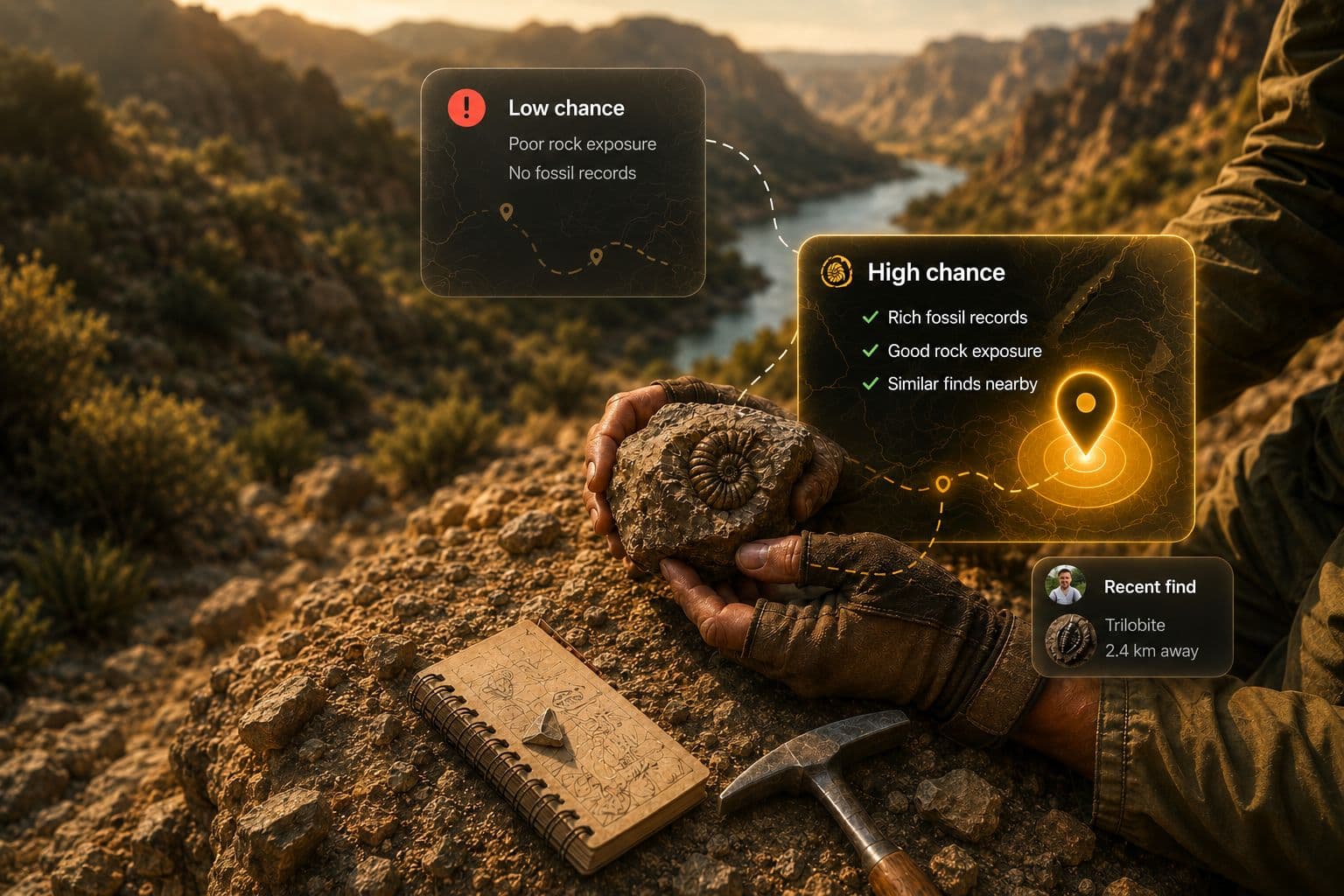
The right rock type still needs to be the right age for the fossil group you want. Trilobites only occur in Cambrian through Permian rock; ammonites in Triassic through Cretaceous. A geological map of your area, or FossilRadar's layer data, tells you both the rock type and its age at a glance, which narrows a large search area down to a specific band of exposed rock. See understanding rock layers and fossil formation for how that dating works.
In the field
Freshly broken or freshly exposed faces show the rock clearest — weathered surfaces are often coated and harder to read. Split shale along its natural bedding planes with a chisel rather than smashing it; fossils often reveal themselves along exactly those planes. If a formation produces nothing after real effort, it may simply be the wrong age or the wrong depositional environment, not a failure of searching.