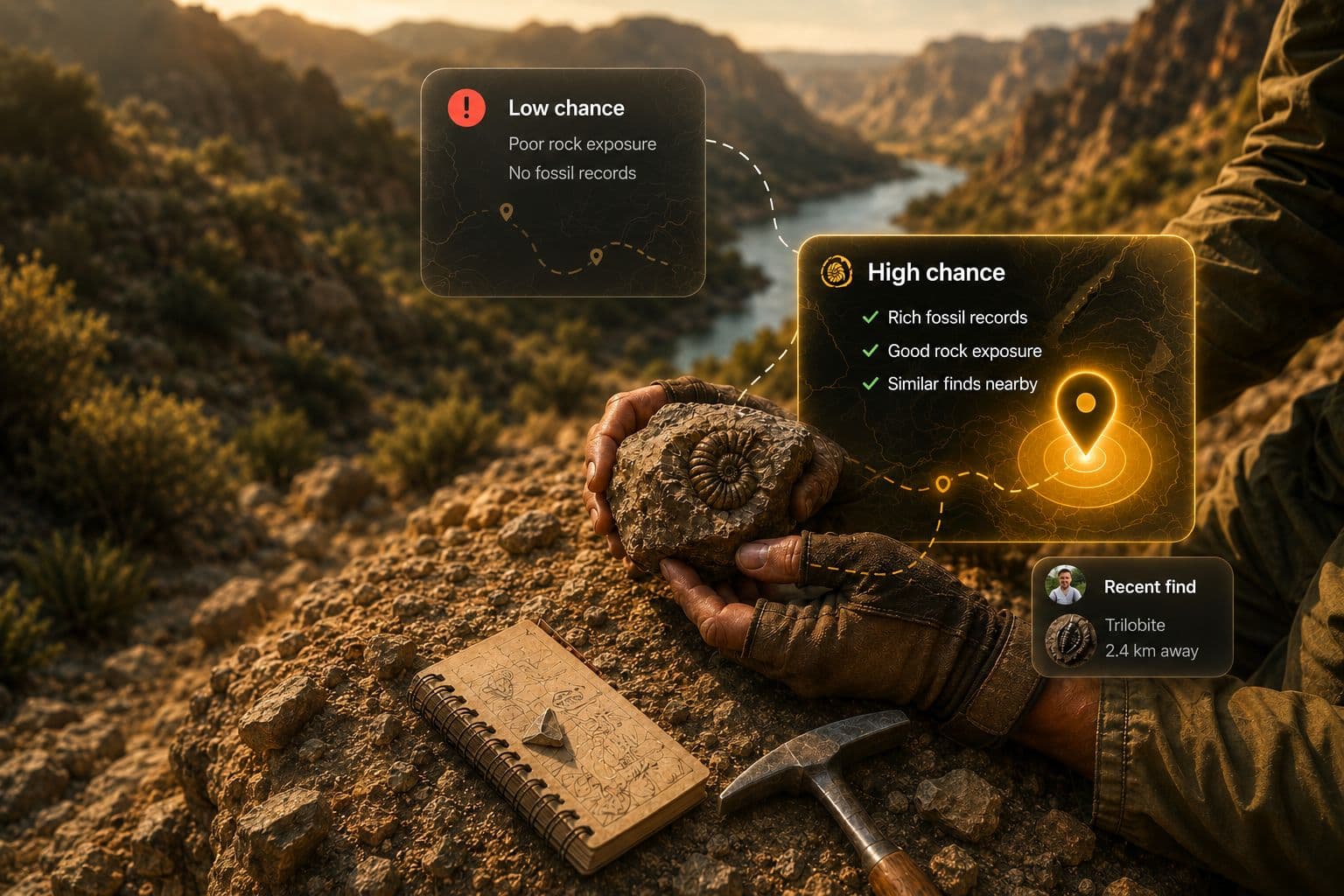
Fossil hunting gets much easier once you stop looking for fossils and start looking for the right rock. Fossils are not scattered randomly through the ground. They occur in specific kinds of rock, formed in specific environments, and knowing which is which eliminates most of the landscape before you leave the house.
The three rock types, and why only one matters
Igneous rock forms from cooled magma or lava. Anything organic caught in molten rock is destroyed. No fossils.
Metamorphic rock is existing rock altered by heat and pressure. Fossils that were present are usually deformed beyond recognition or erased entirely. Occasionally a lightly metamorphosed slate preserves a smeared outline, but you would not plan a trip around it.
Sedimentary rock forms from particles that settle out of water, wind, or ice and are gradually compacted and cemented. Because the process is gentle and gradual, it can bury and preserve. Essentially every fossil you will ever find comes from sedimentary rock.
That single distinction removes most of the map.
The sedimentary rocks worth knowing
Limestone
Formed largely from the accumulated calcium carbonate of marine organisms. Limestone is often not merely fossil-bearing but fossil-*made* — look at a cut face and you may see shell fragments packed edge to edge. Excellent for corals, brachiopods, crinoids, and molluscs.
Shale
Compacted mud and clay, deposited in still water where fine particles could settle undisturbed. Shale splits into flat sheets along its bedding, which is exactly how you open it. Because deposition was quiet and oxygen was often low, shale preserves delicate things other rocks cannot — leaves, insects, soft-bodied animals.
Sandstone
Cemented sand from beaches, dunes, and river channels. Coarser and more porous, so fine detail is often lost, but sandstone is the classic host for tracks, burrows, and larger vertebrate bone.
Chalk
A very fine, soft limestone made largely of microscopic marine algae. Sea urchins, sponges, belemnites, and ammonites are typical.
How a body becomes a fossil
Preservation is rare. The default outcome for a dead organism is complete destruction — scavenged, decayed, dispersed. Fossilisation requires a specific sequence, and every step is a filter.
Rapid burial
The single most important factor. Sediment has to cover the remains before scavengers and decay get to them. This is why the fossil record is heavily biased toward environments where sediment accumulates fast: river deltas, floodplains, shallow seas, lake bottoms. An animal that dies on a dry upland is almost never preserved.
Hard parts survive; soft parts usually do not
Shells, bone, teeth, and wood are mineralised or resistant already. Skin, muscle, and organs decay in days. The fossil record is overwhelmingly a record of hard parts, which is a distortion worth remembering — it is not that ancient life lacked soft-bodied animals, it is that they rarely made it into the rock.
Mineral replacement
Groundwater moves through the buried remains carrying dissolved minerals. Over long periods, those minerals fill the pore spaces and progressively replace the original material, molecule by molecule. Silica, calcite, and pyrite are the common replacements. What you eventually hold is stone in the shape of the original, sometimes retaining structure down to the cellular level.
Compaction and time
The weight of accumulating sediment above compresses everything below. Flattened fossils in shale are the normal outcome of this. The full sequence takes tens of thousands of years at minimum, and usually far longer.
Reading a layered face
Stand in front of an exposed cliff or road cut and you are looking at time stacked vertically.
Superposition is the founding principle: in an undisturbed sequence, lower layers are older than the ones above them. Each bed represents a period of deposition, and a change in the rock — colour, grain size, hardness — marks a change in the environment that produced it.
A shift from shale to sandstone might record a sea retreating and a river system taking over. A band of coal marks a swamp. A sharp surface with rock missing above and below it is an unconformity: a gap where deposition stopped or erosion removed what had accumulated. Unconformities can represent millions of missing years.
This matters practically. Fossils are rarely spread evenly through a face. They concentrate in particular beds, because those beds record the particular conditions under which things were buried intact. Find the productive bed and you can follow it laterally across the whole exposure — and across the next hillside, if the same formation outcrops there.
That is the real skill. Not finding a fossil, but identifying the layer it came from.
What the layers tell you about age
Individual layers can be dated relative to one another by superposition, and absolutely by radiometric dating of volcanic ash beds interleaved with them.
They can also be dated by their contents. Some species existed for a geologically brief interval and were widespread while they existed. Find one and you have dated the layer. These are index fossils, and they are the reason a geologist can look at a hand specimen and name a period.
Trilobites index much of the Paleozoic. Ammonites do the same for the Mesozoic. Certain graptolites resolve intervals of a few hundred thousand years — remarkable precision for a rock hundreds of millions of years old.
Putting it to use
Before a trip, find the geological map for the area and identify which formations outcrop. Note their age and their depositional environment: a shallow marine limestone and a terrestrial floodplain sandstone will yield entirely different things, and knowing which you are standing on tells you what to expect and what to rule out.
Then, on site, look at the face before you look at the ground. Identify the beds. Work out which one is producing. Everything after that is much less a matter of luck.