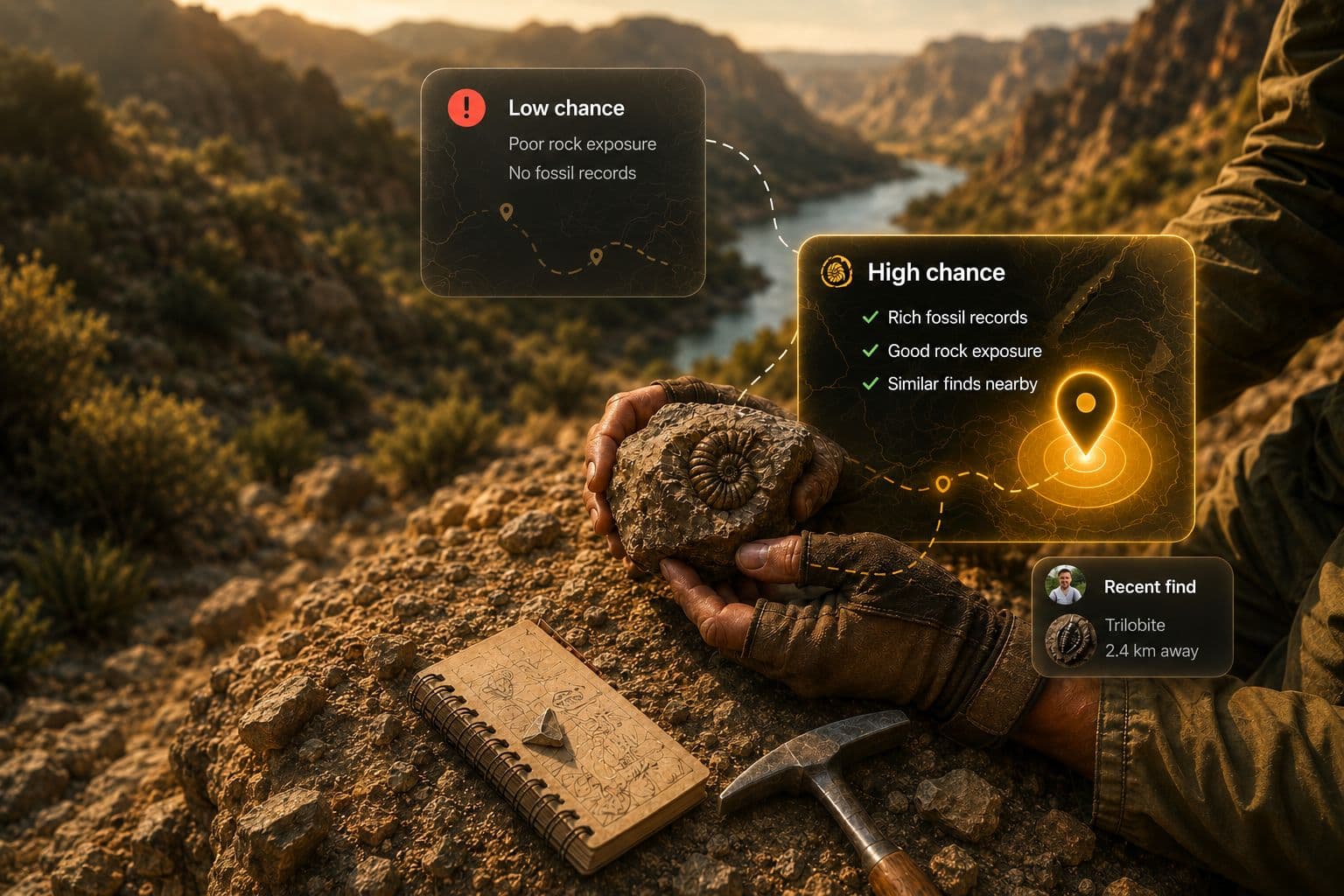

A phone photo can now get you most of the way to an identification, though free tools vary a lot in accuracy and none replace an expert for anything unusual.
What these apps actually do
Fossil identification apps compare a photo against a trained model or a reference database and return a likely group, and sometimes a species and approximate age. They work best on distinctive, well-preserved specimens — a clear ammonite spiral or a trilobite cephalon — and worst on worn, partial, or unusual material, where even experienced collectors disagree.
Getting a usable result
- Photograph on a plain, non-reflective background.
- Use even, natural light — harsh shadows hide the detail an identification depends on.
- Include something for scale, like a coin, in at least one shot.
- Take multiple angles if the specimen has depth or fine structure.
- Photograph any matrix (surrounding rock) too — it can help pin down the formation and therefore the likely age.
FossilRadar's built-in photo identification follows this same principle: a clean, well-lit shot returns the most likely identification along with its group and approximate geological age, so specimens can be logged as they're found rather than researched later.
When an app is not enough
Apps are good at common, recognisable material and weak at anything rare, fragmentary, or scientifically significant. If a result looks important — a vertebrate bone, something that does not match anything the app suggests, or a specimen from a site with a known significant fossil record — a local museum, university geology department, or fossil identification forum with active experts is worth the extra step before assuming the app's answer is final.
Keep the context, not just the photo
An identification is only half the value of a find. Record where it came from as precisely as possible and what rock it sat in — see understanding rock layers and fossil formation — since that context is often what makes a specimen useful beyond a personal collection, and an app cannot recover it after the fact.