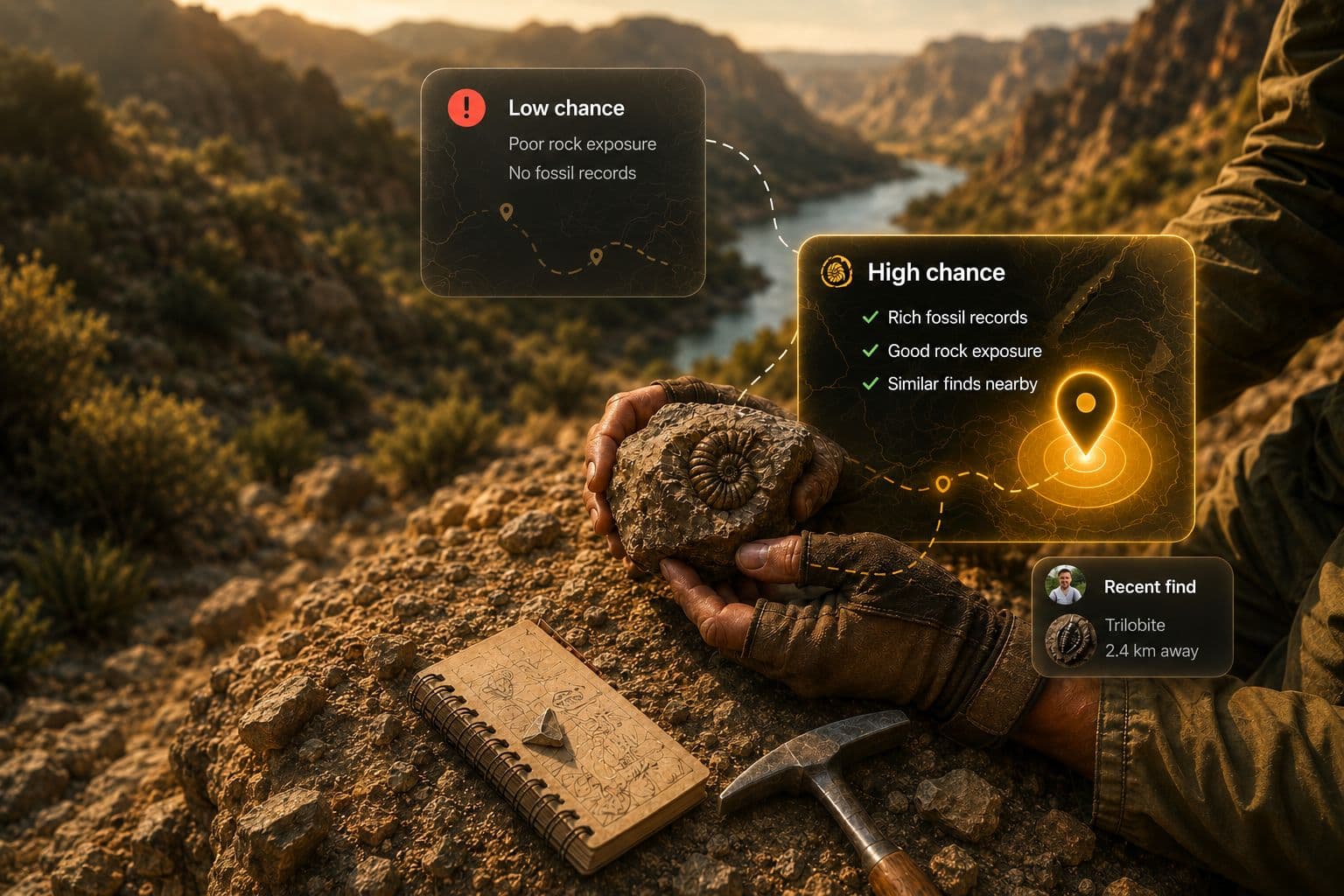
A river is an excavator that never stops working. Every flood scours the channel a little deeper, strips soil off the banks, and drops what it cannot carry on the inside of the next bend. If there are fossils in the rock a river runs through, the river will find them long before you do. Your job is to work out where it put them.
Why rivers are so productive
Most fossil hunting is limited by exposure. Fossils are everywhere in sedimentary rock, but almost all of that rock is buried under soil, grass, and trees. You cannot search what you cannot see.
Rivers solve that problem in two ways at once. They cut down through layers, opening a vertical slice of rock in the banks and bed. And they concentrate what they erode: dense material collects in predictable places while lighter material washes downstream. A fossil is usually a dense object — mineral-replaced bone or shell is heavier than the sand around it — so it behaves like a pebble, not like silt.
That combination is why a half-mile of stream can out-produce a whole hillside.
Reading the channel
Water does not move at the same speed across a river. It runs fast on the outside of a bend and slow on the inside, and that difference controls where material settles.
Point bars
The inside of a bend is where the current stalls and drops its load. These gravel banks — point bars — are the single most reliable place to start. Walk them slowly, at a shallow angle to the light.
Gravel bars and riffles
Anywhere the channel widens or shallows, the water loses energy and coarse material accumulates. Look for the boundary where gravel gives way to sand: heavy items tend to stop right about there.
Downstream of obstructions
A boulder, a fallen tree, or a bedrock ledge creates a slack pocket immediately downstream. Small, dense objects drop out in these eddies and stay put through several floods.
Cut banks
The outside of a bend is being actively eroded, which means the bank face is fresh rock rather than accumulated gravel. This is where you see the layers themselves. If a bed is producing, the cut bank tells you which bed it is — and that is worth far more than a single find.
Timing matters more than technique
The best day to search a river is the first clear day after high water. A flood turns the gravel over, exposes material that has been buried since the last flood, and washes the surface clean.
Spring melt and post-storm flows are the obvious windows. Late summer low water is the other good one, for a different reason: the channel is at its most walkable and bars that sit underwater most of the year are dry and searchable.
A bar picked over in April is worth returning to in October. It is not the same bar.
What you are actually looking for
New hunters scan for shapes. Experienced hunters scan for the things that do not belong.
- Wrong colour. Fossil bone and shell often weather to a different tone than the surrounding gravel — chalky white, deep brown, blue-black.
- Wrong texture. Bone has a spongy internal structure that shows as fine pitting on a broken edge. Nothing inorganic looks quite like it.
- Wrong lustre. Enamel and mineral-replaced shell are glossier than water-worn stone. A wet gravel bar in low sun will show it.
- Wrong geometry. Nature makes very few straight lines, radiating ribs, or repeated segments. Symmetry is a strong signal.
Get low. The single biggest improvement most people make is dropping from standing height to a crouch, where the viewing angle catches surface texture instead of looking straight down onto it.
Working a bar properly
Pick a bar and grid it rather than wandering. Walk the waterline first, then a parallel line a couple of metres up, then again, until you have covered it. Overlapping passes in different light — once with the sun ahead of you, once behind — will turn up material you walked over the first time.
Slow down. A bar that takes ten minutes to cross at a stroll deserves an hour. Most people cover far too much ground far too quickly and see almost none of it.
Legality and etiquette
Rules vary enormously and ignorance is not a defence.
- Rivers frequently run through private land even where the water itself is public. Access rights and collecting rights are separate questions.
- Many public lands allow casual collection of common invertebrate fossils but prohibit vertebrate material entirely. Vertebrate fossils are often protected regardless of where they are found.
- Some regions require a permit for any collecting; some prohibit it outright in protected reaches.
Check before you go, ask permission where land is private, fill any hole you dig, and take nothing from a site that is being actively studied.
Recording the find
A fossil without a location is a curiosity. A fossil with a location is data.
Photograph it in place before you move it. Record the coordinates, the height above the water, and — if you can see it — the bed it weathered out of. Note the date and the water conditions. That record is what lets you return to a productive layer instead of hoping to get lucky on the same bar again.
It is also what makes a find useful to anyone else. Museums routinely decline donated specimens with no locality information, because without it there is very little a researcher can do with them.
A realistic first outing
Choose a stream that cuts through sedimentary rock — limestone, shale, or sandstone. Go on a clear day after high water. Pick one bend with a good point bar. Spend two hours on it and nowhere else.
You may find nothing. That is normal and it is not a wasted trip: you now know the rock type, the access, and the state of the channel, which is most of what you need to choose the next spot well. Rivers reward people who come back.