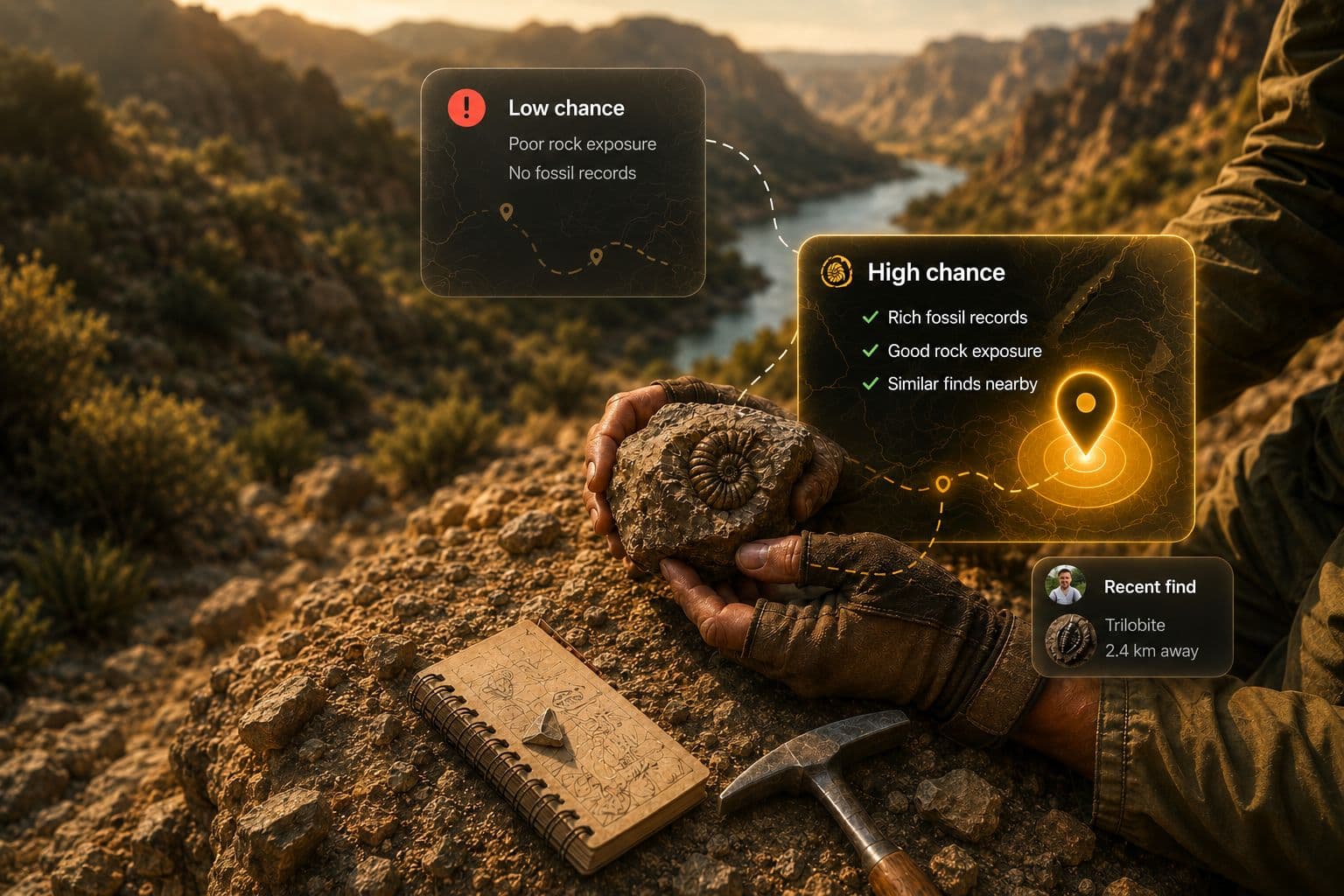

Fossil hunting can pay, but rarely enough to live on, and the money follows the fossil's rarity, condition, and legal status rather than the fact that you found it.
What actually sells
Common invertebrates move steadily but cheaply. Ammonites, shark teeth, trilobites, and crinoid stems sell to collectors and gift shops for a few dollars to a few hundred, depending on size, prep quality, and species. A well-prepared trilobite from a desirable locality can fetch real money; a loose, unprepared fragment usually will not.
Rare and complete specimens are where the larger numbers appear — museum-quality ammonites, articulated fish, insects in amber, and especially vertebrate material can sell for thousands to millions at auction. Those sales are rare events built on years of preparation and provenance work, not a lucky Saturday walk.
The legal ceiling on income
In many countries, vertebrate fossils on public land are protected and cannot legally be sold at all, regardless of how good the find is. Ownership and sale rights depend entirely on where the fossil came from — private land with landowner permission, public land under a permit, or a country with strict export controls. Before you count on selling anything, check the law for the specific site, since it caps what you can legally do with a find far more than the fossil's quality does.
Where the real income is
People who make a living around fossils mostly do not do it by selling their own field finds. They work as commercial dealers buying and reselling from many collectors, as preparators charging for the skilled labor of cleaning and mounting specimens, as guides running paid hunting trips, or as consultants and researchers paid a salary rather than per-fossil. See how much fossil preparators make and is fossil hunting a real job for the career-shaped versions of this question.
The honest answer
Treat fossil hunting as a hobby that occasionally pays for itself — the odd sale covering gas money and gear — rather than an income source. If money is the actual goal, the path runs through preparation skill, dealing, or a paleontology-adjacent job, not through finding one exceptional fossil.